Marcus
Lindberg
Level Design

DISHONORED: TRIBUTE LEVEL

Immersive sim level focusing on stealth traversal and multiple solutions
TL;DR
A stealth-focused level inspired by Dishonored, emphasizing player choice and emergent gameplay.
Designed and iterated on navigation, verticality, and pacing to balance stealth and traversal mechanics.
Showcases attention to readability, environmental storytelling, and problem-solving in level design.
Project Type
Solo
Duration
4 weeks
Role
Level Designer
Engine
Unreal Engine 5
Playable
Documentation

FOUNDATION
First Layout

Paper Design – Initial Concept
The initial paper design focused on creating a highly dynamic level centered around a harbor environment. The core idea was for the player to use Blink to traverse between moving ships in order to reach an assassination target located on an island across the harbor.
Key design elements included:
-
Moving ships that served as traversal platforms
-
A target positioned on an island opposite the player’s starting area
-
Emphasis on verticality and timing-based movement using Blink
After further evaluation, I decided to scrap this concept. The level would have required a very large play space (well beyond 100×100 meters), with a significant amount of unused or low-interaction space in the form of open water. Additionally, the reliance on multiple moving ships and large dynamic elements introduced high technical and design risk, making it unsuitable as a minimum viable project.
Planned dynamic systems included:
-
Ships continuously circling the island
-
A bridge that would open and close as ships approached
Ultimately, I chose to pivot to a more contained and focused design that better supported iteration, readability, and player experience while reducing unnecessary complexity and risk.
Second Layout

Paper Design – Second Concept
The second paper design was more contained and focused, centering around a single large cargo ship with a stronger emphasis on the harbor itself as a fully playable space.
While this concept was not without its flaws, it provided a much simpler and more practical foundation to build upon. The reduced scope made it easier to transition into engine and begin rapid iteration. I often uncover new possibilities and gameplay opportunities once I can actively playtest and explore the space in-engine, which made this approach particularly effective.
This concept was structured around two main playable areas:
-
The harbor
-
The cargo ship
By narrowing the focus and simplifying the core layout, this iteration supported faster prototyping, clearer player flow, and more informed design decisions during early development.
- Make a level inspired by Dishonored
- Showcase my design process
- Multiple intuitive choices and solutions
- Stay true to Dishonored's player agency
- Dynamic/ moving elements in the level
- Build the blockout with modularity in mind
- Target playtime: 5-10 minutes
Design Goals
-
Maximum 100m x 100m
-
Minimum 2 levels of verticality
-
Well defined Start point, and well defined End point
-
Minimum two possible routes
-
Blink and melee gameplay only
-
Use Modular building-blocks from starter content > architecture
Restrictions
-
Player starts at a vantage point in the harbor
-
Player can clearly see the end goal from starting point
-
Patrolling enemies are introduced.
-
Player has two possible entrance points onto the ship
-
Player has two different paths to the goal (lower deck, upper deck)
-
Player needs to disable a "Wall of light" (blocking volume)
-
Reach and assassinate the Captain
Beats
BLOCKOUT
Blockout – First Iteration
After playtesting the first blockout in-engine, it became clear that the experience was too short and overly straightforward for a Dishonored-style level. The layout offered limited opportunities for player expression and did not sufficiently support the core pillars of the immersive sim fantasy: choice, observation, and multiple solutions.
Key issues identified during early playtests:
-
Too few traversal routes, limiting the effective use of Blink
-
Minimal verticality and vantage points for scouting and planning
-
Stealth encounters that would resolved too quickly, reducing tension and decision-making
-
Limited space for alternate approaches such as high ground, indirect paths, or non-lethal playstyles
To address these shortcomings, I expanded the harbor and container area while remaining within the project constraint of a 100×100 meter play space. The goal was to introduce more vertical layers, interconnected paths, and spatial complexity—allowing players to approach objectives in multiple ways while maintaining clear readability and flow.
These problems and constraints directly informed the design decisions explored in the iteration phase, where the focus shifted toward strengthening player agency, pacing, and replayability in line with Dishonored’s design philosophy.


Questions during Blockout
-
How big are containers?
-
How big are cargoships?
-
Start on top of containers or roof?
-
What is blocking the player from going onto the ship to fast?
-
Different entrance points?
-
Focus gameplay on harbor or ship?
-
Multiple levels (lower-/ upper deck) on the ship?
-
Dynamic/ moving containers?
ITERATION
Design Decisions & Problem Solving
Based on issues identified during the blockout phase, the iteration process focused on increasing player agency, improving pacing, and better supporting Dishonored’s immersive-sim gameplay: multiple approaches, verticality, and meaningful choice.


Iteration (4 out of 8) example

Blink Path Balancing
Problem:
The Blink ability allowed players to bypass large portions of the level, creating unbalanced paths and skipping intended gameplay.
Solution:
I iterated on platform placement and guard positioning to introduce clearer risk–reward choices and limit unintended shortcuts without restricting player freedom.
Result:
Traversal paths became more balanced, preserving creative Blink usage while maintaining pacing and encounter relevance.
Before:
After:
Gating Ship Access
Problem:
Experienced Dishonored players misinterpreted the Wall of Light as a system to disable using whale oil, which conflicted with my intended purpose of simply delaying access to the ship.
Solution:
After testing several alternatives, I rotated the ship and moved it farther out into the harbor, using spatial layout and distance—rather than hard gating—to control player progression.
Result:
This allowed me to remove the Wall of Light entirely, aligning player expectations with the level’s design intent while preserving immersion and player agency.
Before:
After:


-
Player starts at a vantage point in the harbor
-
Player can clearly see the ship from the start
-
Player can scout/ plan their approach from the rooftops
-
Player has multiple possible entrance points onto the ship
-
Player need to find two targets to eliminate (lower deck, upper deck)
-
Player needs to escape from the area.
-
Target playtime 10-15min
Iterated
Beats
Playtests
Playtesting – Validation & Iteration
I conducted observed playtests with 7 unique players, watching each complete the level without giving guidance or feedback during play. Roughly half of the playtesters had no prior experience with Dishonored, helping validate readability for both new and experienced players.
After playtesting, players were asked to complete a short survey about their experience (4/7 responses).
Key Insights
-
Both major issues identified earlier—Blink path balancing and gating ship access—were consistently surfaced during playtests and informed iteration decisions.
-
Experienced players attempted to bypass intended progression using Blink, confirming the need for traversal rebalancing.
-
New players were still able to understand goals and navigate the level, suggesting improved clarity and onboarding.
Player Feedback Highlights
-
Players strongly appreciated the multiple approaches and traversal options, particularly the container/crane route onto the ship.
-
Several players described satisfaction in reading the logic of the space and executing systemic solutions.
-
Blink was consistently cited as fun and empowering, validating its central role in traversal design.
-
Feedback also revealed opportunities to better reward longer or less obvious routes, informing future polish.
Outcome
The final iteration resolved the two main problem areas while maintaining player freedom. Playtesting confirmed improved pacing, clearer progression, and a stronger balance between player expression and level structure.
Iteration 8
Result
Closing Notes
This level lays a strong foundation, but there is still room for extra polish and environmental storytelling. Details like why the ship is tilted, NPC interactions, and environmental clues could further deepen immersion—for example, adding speaker voicelines, ambient conversations, or barks to hint at past events like the container accident and why the dock is on standby.
In a team setting, I would also iterate on the crane event to make it more dynamic, using NPC reactions and environmental feedback to guide the player and reinforce the world’s systems. These refinements would enhance player engagement while staying true to Dishonored’s immersive-sim design philosophy.


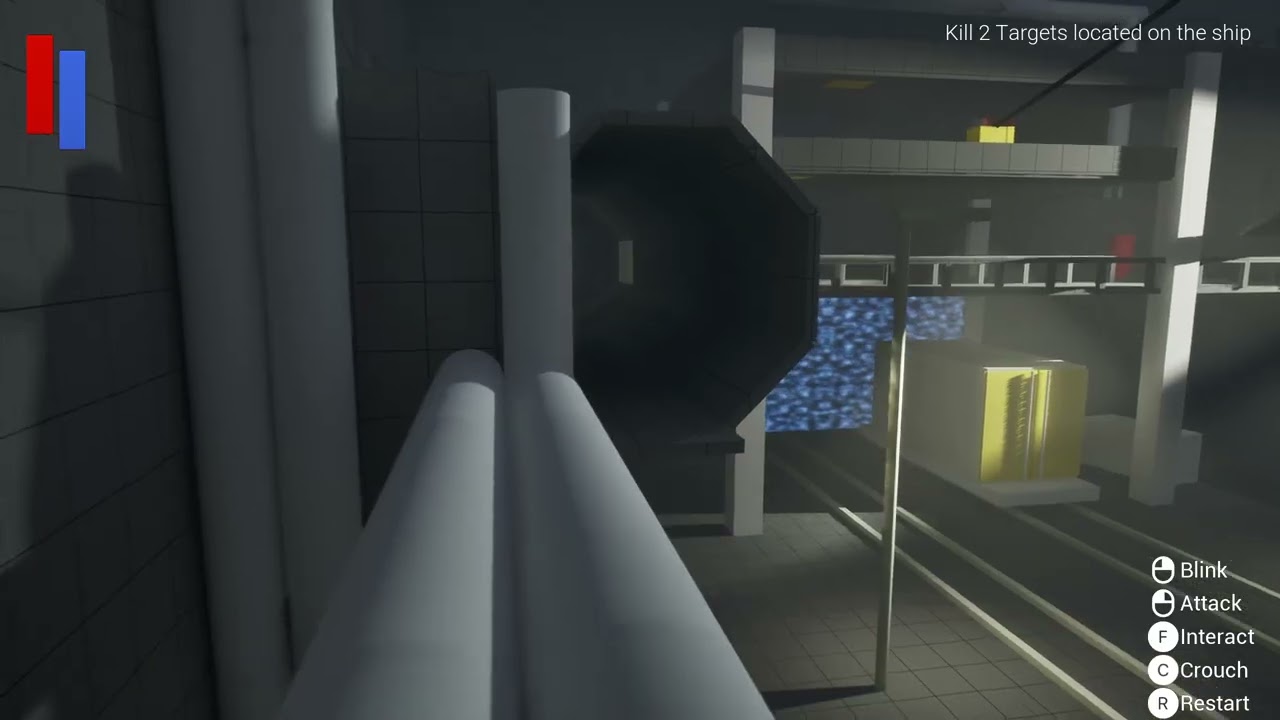
Pipe: access to the ships rear.

Start: Vantage point

Container event:
Unlocks new Infiltration option

Power Puzzle: access to the ship by removing power
GAMEPLAY
Below are three main "golden path" examples to get on to the ship.
Design beat intent:
-
Scout the area through high vantage-points
-
Find a way onto the ship, through one of many solutions
-
Kill the two "orange" targets
-
Escape
Container solution

Ship rear solution
Turning off electricity solution

Ship gameplay example
